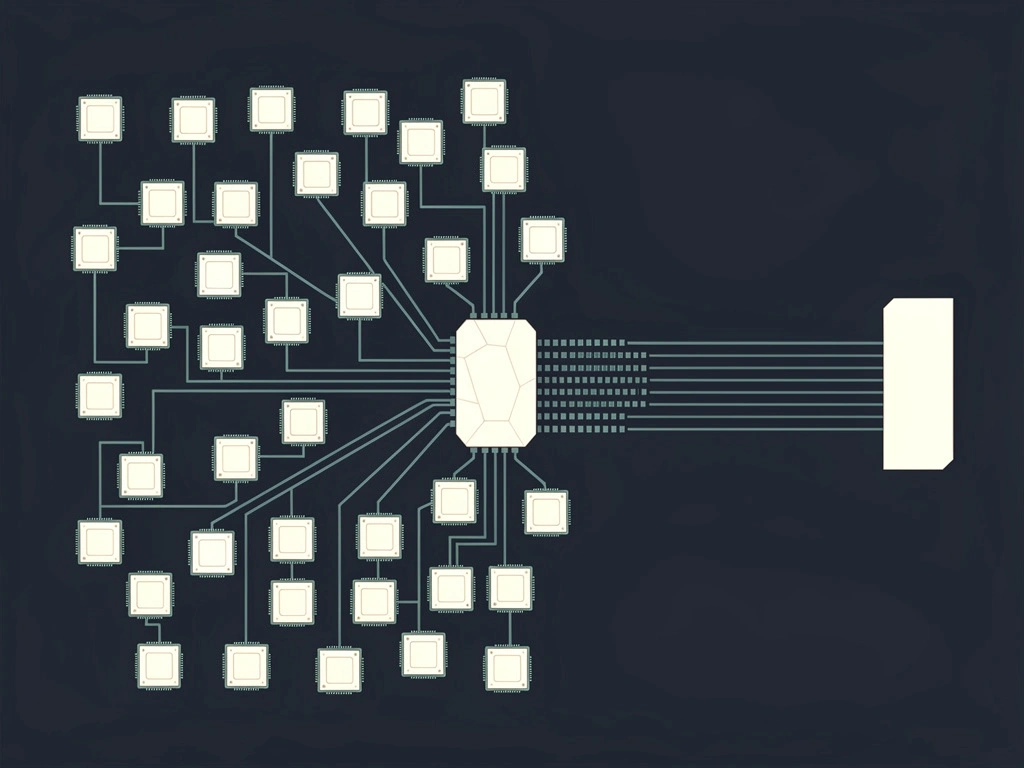
Nous Research
Independent Nous Research review: the Psyche distributed-training network, the Hermes models, the Paradigm-backed raise, and the pre-TGE token question.
The strongest decentralised pre-training story in DeAI. Consilience 40B trained over the internet for 20 trillion tokens on Psyche. Hermes 4.3 trained start-to-finish on the same network. The catch sits in the cap table. A $1B SAFT round led by Paradigm puts venture capital between the technology and any future public token holder, and TGE terms are still unannounced.
- + Production training runs on Psyche with public weights: Consilience 40B (20T tokens) and Hermes 4.3 (36B) both shipped
- + Founder-coded production system. CEO Jeffrey Quesnelle is the top contributor to PsycheFoundation/psyche
- + Order-of-magnitude open-source pickup: hermes-agent at 230k GitHub stars, verified via API
- − Heavy SAFT cap table. $65M of venture capital priced in at $1B before any public token holder gets access
- − Pre-TGE. No published token spec, vesting schedule, or fair-launch commitment
- − Single-jurisdiction US corporate entity. Open weights are sovereign, the company is not
Total 51/100. The open-source and infrastructure dimensions are unusually strong for a pre-token project; the heavy VC capture and absence of any token-based governance drag the score into D territory. This is the strongest decentralised pre-training story in DeAI, rated honestly as a research lab with venture-grade ownership rather than a permissionless network with sovereign holders.
Infrastructure decentralisation11/20
Psyche deploys four public Solana programs (coordinator, authorizer, treasurer, mining-pool) with on-chain program IDs. Hermes 4.3 was trained end-to-end on Psyche at 144,000 tokens per second across 24 nodes, demonstrating real production capacity. Consilience 40B reached 20 trillion training tokens via Psyche. The architecture is permissionless in design. Discounts: project documentation explicitly does not use the word mainnet (the team describes the post-testnet phase as 'next phase'); active participant and node counts are not publicly verifiable because the psyche.network dashboard is JS-rendered.
Governance decentralisation3/20
Founder-led, no DAO, no on-chain governance, no token-based voting. Decisions made by the four-person founding team (Quesnelle, Malhotra, Teknium, Mitra). Paradigm holds a meaningful SAFT stake from the April 2025 Series A. No published transition plan to community governance post-TGE.
Token distribution fairness4/15
Pre-TGE but Paradigm-led $50M Series A at $1B SAFT valuation plus ~$15M prior from Distributed Global, North Island Ventures, Delphi Digital, Together AI, and Raj Gokal totals $65M of insider capital before any public participant gets access. The team has not committed to a fair-launch model and Karan Malhotra told Fortune the decision between proprietary token and Solana SOL was open. Pre-TGE scoring reflects the heavy SAFT cap table; final score will be revisited at TGE.
Censorship resistance9/15
Hermes models are downloadable weights on HuggingFace and run locally with no entity able to revoke. Hermes 4 Technical Report shows lower refusal rates than peer models on RefusalBench. Psyche programs on Solana are permissionless for anyone to interact with. Discounts: Nous Portal API is a centralised US-jurisdiction service; HuggingFace itself is a US-hosted distribution channel; the corporate entity is subject to US legal process.
Data sovereignty10/15
Local inference via GGUF and MLX quantisations is fully sovereign once downloaded. Training data sources are publicly attributable (FineWeb, Common Crawl mix). Psyche participant nodes hold partial state but coordination data is on a public Solana chain, which is both a transparency feature and a metadata exposure. No zero-knowledge or confidential-compute layer at coordination time.
Open source transparency14/15
91 public repos. Psyche under Apache-2.0 with 22 active contributors including CEO Quesnelle. Hermes Agent under MIT with 229,979 stars (verified via GitHub API 2026-08-14). DisTrO preliminary report and Hermes 4 Technical Report published on arXiv. All Hermes models and Consilience 40B published with open weights and full model cards. Slight discount: we found no public disclosure of the company's financial structure, state of incorporation or TGE plans.
Not financial advice. Scores are opinions, not recommendations. Crypto is high-risk – you could lose everything you invest. Full disclaimer.
Embed this rating

The badge updates automatically when the score changes.
On this page
What it does
Nous Research is a US-based AI research lab building two intersecting products. Psyche is a coordination layer for distributed model trainingTrainingThe one-time process of teaching a neural network to perform a task by showing it massive amounts of example data and adjusting its internal weights until the outputs are good. Training builds the model; inference uses it.Like the years an apprentice spends learning a trade. You don't see any of the actual work, just thousands of repeated mistakes gradually becoming competence. By the end, the apprentice can do the job. The training was invisible, but the skill is now permanent.Read more → that uses Solana smart contracts to register participants, schedule training rounds, and settle work. Hermes is the open-weight model family that ships out the other end. The connective tissue is DisTrODisTrODistributed Training Over the Internet. A family of gradient-compression algorithms from Nous Research that lets large language models train across consumer-grade internet links instead of high-speed data-centre interconnects.Think of training a 70B model across the internet as a video call with 100 people, each holding a stack of files. DisTrO is the compression that lets everyone trade summaries instead of full files. The conversation still works, the line doesn't drop, and the meeting finishes in hours instead of weeks.Read more →, a gradient-compression stack that lets a 40-billion-parameter modelModelA trained neural network that takes inputs (text, images, audio) and produces outputs (more text, classifications, generated content). In DeAI the model is the thing that actually does the work.Like a very experienced apprentice who has spent years watching thousands of masters make furniture. They can't explain how they know when a joint is right, but they can make a chair that looks and functions like a Chippendale. The training is invisible. The output is what matters.Read more → train across the public internet without needing data-centre interconnects.
The lab was an informal Discord research collective in 2022 and incorporated as Nous Research, Inc. in May 2023 (GitHub organisation creation date is the cleanest primary anchor). The founding team is four people: Jeffrey Quesnelle (CEO), Karan Malhotra (Head of Behavior), Ryan “Teknium” Teknium (Head of Post-Training), and Shivani Mitra. Headquarters in New York with a fully remote workforce per the careers page.
Funding to date is approximately $65 million across two rounds. Distributed Global led roughly $15 million of pre-Series-A capital with participation from North Island Ventures, Delphi Digital, Together AI, and Solana co-founder Raj Gokal. Paradigm then led a $50 million Series A in April 2025 at a $1 billion token valuation via SAFTSAFTSimple Agreement for Future Tokens. A contract that grants an investor the right to receive a project's tokens at TGE, usually at a steep discount to the public price, in exchange for capital paid today.Like buying a property off-the-plan years before the building is finished. You pay now, you get title later, the developer gets the funding to build, and the early discount is the reward for taking the risk that construction never finishes.Read more →. No official Nous token has launched. Karan Malhotra told Fortune at the time of the Paradigm round that the team had not decided whether to issue a proprietary token or use Solana’s native SOL as the coordination asset.
Psyche is the network side of the business. Four programs are deployed on Solana with public IDs: a coordinator, an authorizer, a treasurer, and a mining pool. The codebase is Apache-2.0, hosted at PsycheFoundation/psyche, with 22 contributors including CEO Quesnelle as the top committer under the handle jquesnelle. The documentation does not formally use the word mainnet. The September 2025 blog post describes the post-testnet phase as “the next phase of Psyche,” and the docs file lists mainnet under “not discussed in this documentation.” Production training runs are happening on the network today; the project has chosen not to label that as a graduation.
Hermes is the model side. The Hermes 4 family launched in August 2025 across three Llama-3.1 and Qwen3 base sizes (14B, 70B, 405B). Hermes 4.3 (36B, December 2025) is the first to be trained in full on Psyche, hitting 144,000 tokens per second across 24 nodes. Consilience 40B is the lab’s headline pre-training artifact: a dense decoder using DeepSeek v3 architecture plus Multi-head Latent Attention, trained on Psyche for 20 trillion tokens. The weights live on HuggingFace under a dual CC0-1.0 and MIT licence.
Value proposition
Production training, not testnet
Hermes 4.3 (36B) trained in full on Psyche at 144k tokens/sec across 24 nodes. Consilience 40B reached 20T training tokens via the network.
Open weights, open papers
Hermes Agent 230k stars on GitHub. Psyche under Apache-2.0. DisTrO preliminary report and Hermes 4 paper on arXiv.
Heavy SAFT cap table
$50M Paradigm Series A at $1B token valuation plus roughly $15M prior from Distributed Global, North Island Ventures, Delphi Digital, Together AI, Raj Gokal.
The pitch is straightforward. Pre-trainingPretrainingThe first and most expensive phase of training a large language model. The model starts from random weights and learns language by predicting tokens across trillions of words. Distinct from fine-tuning, which adapts a pretrained model.Pretraining is medical school. Years of grinding through textbooks before you know anything specific. Fine-tuning is the residency that turns the graduate into a cardiologist. Both are training, but they cost very different amounts and produce very different things.Read more → a frontier-scale model in a centralised data centre is a club with maybe ten members worldwide. Each member runs their training on tens of thousands of high-end GPUsGPUGraphics Processing Unit. Originally designed to render video game graphics, GPUs turned out to be exceptionally good at the massively parallel math that AI models need. Modern AI training and inference runs almost entirely on GPUs.Like a factory with 10,000 workers doing the same simple task in parallel, versus a CPU which is more like 10 workers each doing different complex tasks. AI training involves doing simple math a million times per second on a million numbers, which is exactly what the GPU factory is designed for.Read more → connected by InfiniBand and writes a cheque measured in the hundreds of millions of dollars. Decentralised pre-training across the public internet would change that calculus. The catch is that pushing gradient updates across consumer broadband is roughly a thousand times slower than across a data-centre fabric. DisTrO is the compression layer that closes the gap.
What separates Nous from peers is that the lab has actually shipped at scale. Consilience 40B reached 20 trillion training tokens over the internet on Psyche. That is the largest publicly verifiable decentralised pre-training run anyone has published. For comparison, Llama 3.1 405B was pretrained on 15 trillion tokens (centralised), and most open-weight base models sit well below 10 trillion. The lab also published the DisTrO preliminary report (arXiv, August 2024), the Hermes 4 Technical Report (arXiv, August 2025), and the MoE scaling field notes describing 15,057 tokens per second per GPU on a 128-GPU B200 cluster. The papers and the weights line up. The runs check out.
The Hermes family is the lab’s commercial wedge. Hermes 4.3 is downloadable via GGUF for local inferenceInferenceRunning a trained AI model to produce an answer. Inference is what happens when you type a prompt into ChatGPT and get a response. The model takes your input, computes a best guess, and returns it.Like asking an expert for their opinion. The training was the decades they spent becoming an expert. The inference is the 30 seconds it takes them to answer your specific question.Read more → and via the Nous Portal API for hosted inference at portal.nousresearch.com. Independent benchmarks via Artificial Analysis price Hermes 4-70B at around $0.13/$0.40 per million tokens via third-party hosts, and Hermes 4-405B at around $1.00/$3.00 per million tokens. Hermes Agent, the open-source agent runtime, sits at 229,979 stars and 45,460 forks on GitHub (verified via the GitHub API, August 2026). For context, that is an order of magnitude above the next-largest open-source DeAI tooling repo we cover. Community pickup is the strongest competitive signal on the board.
The counter-narrative is the cap table. A $1 billion SAFT-implied valuation is venture capital pricing in expected token upside before anyone outside the institutional cap table has had a chance to buy. The decentralised in “decentralised AI” describes the technique here, not yet the ownership. Paradigm, Distributed Global, North Island Ventures, Delphi Digital, Together AI, and Raj Gokal have first claim on whatever token launches. The Token Distribution Fairness score in this review reflects that arithmetic.
The other counter-narrative is the framing of Psyche itself. The project does not use the word mainnet in its current documentation. The training runs are active and the Solana programs are deployed, so the network is functionally live. Sticking with “next phase” rather than declaring mainnet leaves the team optionality on what the eventual graduated network looks like, which is a sensible engineering choice and an editorial complication. We score the infrastructure dimension on what is actually shipped, with a discount for the missing formal declaration.
Tokenomics
There is no official Nous token. The $1 billion figure that travels with this project is the SAFT-implied fully diluted valuation from the Paradigm Series A in April 2025, set by the documents the institutional buyers signed. It is a venture price, not a public market price. Pre-TGETGEToken Generation Event. The moment a project's token first becomes tradeable. TGE is when vesting clocks usually start, when liquidity hits exchanges, and when public price discovery begins.Like the IPO day for a startup. Everything that happened before TGE was private valuations and paper agreements. Everything after is the public market deciding what the thing is worth in real time.Read more → reviews always come with this caveat: the supply curve, the vesting schedule, and the public allocation are all unannounced. Everything below should be read as the structural shape implied by what has been disclosed, with the understanding that the actual launch terms can move the score meaningfully in either direction.
What is reasonably knowable. The SAFT cap table is concentrated. Paradigm leads, with five other named investors holding meaningful positions. SAFT structures typically come with multi-year vestingVestingA schedule that locks up tokens allocated to insiders, investors, and team members, releasing them gradually over months or years. Vesting prevents insiders from dumping on public buyers immediately after launch.Like a new employee's stock options at a startup. You don't get all the shares on day one. They unlock over four years so you stick around and do the work rather than cashing out and leaving.Read more → and a cliffCliffA waiting period at the start of a token vesting schedule during which no tokens unlock at all. After the cliff ends, tokens begin releasing according to the vesting schedule.Like a probationary period at a new job. You don't get your stock options on day one. You wait 12 months to prove you'll stick around, then everything starts unlocking normally.Read more →, so insider sell pressure at TGE is usually deferred but not absent. Whatever proportion of total supply the SAFT covers, the cap table will dominate the early float once that vesting starts releasing. By Distributed Global and North Island Ventures naming conventions, the prior-round investors are sitting on much earlier strike prices than Paradigm, which compounds the structural overhang.
What is unknown. Whether Nous launches a proprietary token (call it NOUS or PSY) or uses SOL as the Psyche coordination asset. Whether there is a fair public allocation tranche (an airdrop, a public sale, a participant-only mining mechanism). Whether the four Solana programs already on chain become the canonical token-economy hooks or whether the team rebuilds the coordination layer to accommodate a new asset. Karan Malhotra’s April 2025 comment that the decision was still open suggests there is active internal debate about the launch model. A community-aligned launch is possible. So is a standard venture-priced TGE that hands the early float to insiders.
Warning on the unofficial pump.fun NOUS token. A pump.fun contract at C42Wzk8rSnETpktCUofXJ5eAf9VW4GRU12ePuwqEpump carries the NOUS ticker on Solana and gets mistaken for an official Nous Research launch in retail trading channels. It is not. Phantom labels the contract unverified. As of publication: locked liquidityLiquidityHow easily a token can be bought or sold without moving the price. High liquidity means you can enter or exit large positions quickly at the quoted price. Low liquidity means even small trades can swing the market.Like the difference between selling a house and selling a share of Apple stock. The house might be worth more on paper, but finding a buyer at that price takes weeks. The Apple share converts to cash in one click.Read more → approximately $4,331, 24-hour volume $0, 47 holders, pool age roughly one year, GeckoTerminal Security Score 50 out of 100. A separate unofficial contract carrying the NOUS symbol also exists on Ethereum at 0x36096eb8c11729fdd7685d5e1b82b17d542c38ce and is equally unaffiliated with the lab. Do not interact with either. If and when Nous launches an official token, the team will announce it through nousresearch.com and the @NousResearch X account, not via a pump.fun or DEX listing.
How to participate
Download Hermes models and run them locally. The lowest-friction entry point. The Hermes 4 family is on HuggingFace under NousResearch with GGUF quantisations for llama.cpp and Ollama and MLX builds for Apple Silicon. Hermes 4-14B runs on a 16-32GB Mac at decent speed. Hermes 4.3 36B needs more memory but still fits on consumer hardware in a quantised build. Consilience 40B is the heaviest of the public weights and is more of a research artifact than a daily-driver model. All open weightsOpen WeightsAn AI model whose trained parameters are publicly published and downloadable, so anyone can run, fine-tune, or modify it without permission. Llama, Qwen, DeepSeek, Mistral, and Hermes are open-weight models.Like the difference between a published recipe and a restaurant's secret formula. Anyone with the recipe can cook the dish at home, modify it, or open their own restaurant. The secret formula stays locked in someone else's kitchen.Read more →, all under permissive licences.
Use the Nous Portal API. Hosted inference for Hermes models at portal.nousresearch.com. Pay-per-token commercial access, useful for prototyping against Hermes without the local hardware requirement. Pricing per Artificial Analysis-reported third-party hosts puts Hermes 4-70B near $0.13 input / $0.40 output per million tokens and Hermes 4-405B near $1.00 / $3.00.
Run a Psyche training node. The Apache-2.0 codebase at PsycheFoundation/psyche includes the Solana programs and the off-chain trainer. Node operation requires GPU hardware and Rust or Python familiarity; the specific requirements vary by active run. Pre-TGE there is no token-denominated reward; participation today is contribution-driven, with future incentives undefined.
Contribute to the codebase. Ninety-one public repos on the NousResearch GitHub organisation (August 2026). The headline projects: PsycheFoundation/nousnet (network coordination, renamed from PsycheFoundation/psyche), NousResearch/DisTrO (compression substrate), NousResearch/hermes-agent (agent runtime, 230k stars), NousResearch/atropos (RL environment, 1,344 stars), NousResearch/Hermes-Function-Calling (1,441 stars). All Apache-2.0 or MIT. The community is sufficiently active that meaningful pull requests get reviewed quickly.
Honest assessment
What works
Nous is shipping the thing on the box. Consilience 40B exists as downloadable weights with 20 trillion training tokens behind it, trained over the internet on Psyche. That is the largest verifiable run of its kind anywhere. Hermes 4.3 was trained start-to-finish on the same network at industrial pace. The papers, the model cards, and the on-chain coordinator programs all line up. For a category that has spent the last three years getting laughed off as “you can’t train across the internet,” that is a meaningful refutation.
The open-source momentum is in a separate bracket from peers. Hermes Agent at 229,979 stars on GitHub sits in rare territory for any GitHub repo and is an order of magnitude above any other DeAI tooling we cover. Cross-checking via the GitHub API in August 2026 confirms the number. The Hermes lineage carries community goodwill that predates the corporate entity, and Teknium remains one of the most prominent open-source ML voices on X. The Psyche repo, now PsycheFoundation/nousnet, at 955 stars with 22 active contributors including the CEO is a much smaller community but, as a network-coordination codebase, perfectly healthy.
The founders are coding the production system. Jeffrey Quesnelle is the top committer on PsycheFoundation/psyche. The contributor list reads as engineers, not consultants. That reduces a category of execution risk that flattens a lot of DeAI projects where the visible team and the actual code authors are different people.
What doesn’t work
No mainnet declaration. The project chooses not to use the word, and the architectural reality is that the four Solana programs are deployed and used but the framing is “next phase,” not graduated. Participant counts, node counts, and training-run dashboards exist as JavaScript-rendered web pages that we could not parse directly. For a network that prides itself on verifiability, the public observability story is thinner than the engineering would suggest.
The cap table is not decentralised. $65 million of venture capital sat in this project before any public participant got to buy a single share of upside. The Paradigm-led Series A is priced at $1 billion of token value via SAFT. Distributed Global, North Island Ventures, Delphi Digital, Together AI, and Raj Gokal hold the prior round. The Token Distribution Fairness score in the next section reflects that, and any community-aligned launch model will need to be visibly imposed on top of that starting position.
No published value-accrual mechanism. Nous Portal API generates inference revenue today, and that revenue flows to the corporate entity. There is no committed buy-and-burn, no staking yield, no fee-sharing arrangement with a future token. Holders of a hypothetical NOUS token would be buying into utility that has not been specified.
The risk
The TGE structure is the single biggest variable in this review. A well-designed launch (meaningful public tranche, transparent vesting, governance pathway) lifts Token Distribution Fairness, Governance, and Value Accrual scores in ways that could move the project from a D into a clean B. A standard venture-priced launch (insider-heavy float, short cliff, no governance) confirms the current scoring and probably tightens it down. Karan Malhotra’s open-question framing in April 2025 suggests both outcomes are still live.
Concentrated technical leadership. The four-person founding team carries the lab. Departure of any of the four, particularly Teknium (community face) or Quesnelle (production code), would materially affect roadmap delivery. That is a normal risk for a small lab, with one twist: the brand equity here is unusually concentrated.
Single-jurisdiction US corporate entity. The open weights are sovereign once downloaded, but Nous Research, Inc. is subject to US legal process. HuggingFace, where the models are hosted, is a US company. Nothing about the current setup is censorship-resistant at the company layer.
The pump.fun NOUS contract on Solana keeps catching retail buyers. Without a direct on-record disavowal from the team, the contract can be expected to keep absorbing capital from people who think they are buying a Nous token. The contract is unrelated to the lab and worthless on the metrics.
My position
I don’t hold any Nous-related tokens because no official Nous token exists. Hermes 4.3 is downloaded on my Mac, and Consilience 40B sits on the to-read list as a research artifact rather than a daily driver. I’d be a buyer of an actual NOUS token at a sensible public price post-TGE, gated on what the launch terms look like for non-SAFT participants. Pre-TGE, the participation route I’d recommend is the contribution one: run a Psyche node if you have GPU capacity, contribute to the Apache-2.0 codebase, or use the open weights locally. The Paradigm-led venture round priced the speculative case at $1 billion. The Freedom and Returns scores in this review price the network at what is actually on chain and downloadable today, which is much less, but built on a more honest base.
Freedom Score: 51/100
Nous Research scores 51/100 (D grade). Full methodology at Freedom Score Methodology.
Infrastructure decentralisation (11/20): Psyche deploys four public Solana programs (coordinator, authorizer, treasurer, mining pool). Hermes 4.3 was trained in full on the network at 144,000 tokens per second across 24 nodes. Consilience 40B reached 20 trillion training tokens via Psyche. The design is permissionless and the production runs are verifiable on-chain. Discounts: the project documentation does not formally use the word mainnet (the current phase is described as “next phase”); active participant and node counts are not publicly verifiable; the docs explicitly list mainnet under topics “not discussed in this documentation.”
Governance decentralisation (3/20): Founder-led with no DAODAODecentralised Autonomous Organisation. A way to coordinate decisions and manage a treasury using token-weighted voting instead of a traditional company structure. Token holders propose and vote on changes directly.Like a shareholder-run company where every shareholder can vote on every decision, the votes are public, and the company can't do anything the shareholders don't approve. The coordination is messier than a normal company but nobody has unilateral control.Read more →, no on-chain governance, and no token-based voting. The four-person founding team makes all decisions. Paradigm holds a meaningful SAFT position from the April 2025 Series A. No published transition plan from corporate governance to community governance post-TGE.
Token distribution fairness (4/15): Pre-TGE, scored on the SAFT-implied structure. Paradigm-led $50 million Series A at $1 billion plus roughly $15 million of prior capital from Distributed Global, North Island Ventures, Delphi Digital, Together AI, and Raj Gokal totals $65 million of insider capital before any public participant gets access. The team has not committed to a fair launchFair LaunchA token launch where everyone has the same access from day one. No private sale, no insider allocation, no VC discount. Tokens are distributed by mining, staking, or open public sale at a single price.Like a 100m sprint where everyone starts behind the same line at the same time. Some runners are faster, but nobody gets to start 10 metres ahead because they paid extra. The race is decided by the run, not by who bought the best position.Read more → and the proprietary-token-versus-SOL decision remains open. Final score will be re-evaluated at TGE.
Censorship resistance (9/15): Hermes models are open weights on HuggingFace and run locally with no entity able to revoke them. The Hermes 4 Technical Report shows lower refusal rates than peer models on RefusalBench. Psyche programs on Solana are permissionless. Discounts: Nous Portal API is a centralised US-jurisdiction service; HuggingFace is a US-hosted distribution channel; the corporate entity is subject to US legal process.
Data sovereignty (10/15): Local inference via GGUF and MLX is fully sovereign once weights are downloaded. Training data sources are publicly attributable (FineWeb plus Common Crawl mix). Psyche participant nodes hold partial state but coordination data sits on a public Solana chain, which is a transparency feature and a metadata-exposure feature simultaneously. No zero-knowledge or confidential-computeConfidential ComputeHardware-enforced computation where data and code are encrypted in memory and only the authorised application can access them. The machine's operator cannot read what the application is doing even though they own the machine.Like renting space in a bank vault. The bank owns the building and runs the security, but what you put in the vault is invisible even to the bank staff. Only you have the key.Read more → layer at coordination time.
Open source and transparency (14/15): Ninety-one public repos. Psyche under Apache-2.0 with 22 active contributors including the CEO. Hermes Agent under MIT with 229,979 stars (verified via GitHub API, August 2026). DisTrO preliminary report and Hermes 4 Technical Report on arXiv. Consilience 40B and all Hermes models published with open weights and full model cards. Small discount: company financial structure, state of incorporation, and TGE plans not disclosed.
Path to improvement
Three changes would materially lift the Freedom score:
- Declare mainnet and publish a participant dashboard. Production runs are happening on Psyche today. Naming the current state as mainnet (or as a clearly defined post-mainnet phase with a public on-chain dashboard showing active nodes, training-run status, and compute hours contributed) would convert engineering reality into editorial credibility.
- Commit to a fair public allocation at TGE. A meaningful public sale, airdrop to Psyche contributors, or participant-only mining tranche would change the Token Distribution Fairness picture. The current SAFT-only cap table scores poorly; any visible community share would lift it.
- Publish a governance transition plan. A roadmap from founder-led decision-making to token-based or council-based governance, with concrete dates and decision categories, would address the Governance score directly. The lab has the technical and community credibility to land this well; the absence of the plan is what holds the score down.
Returns: N/A (pre-token)
Nous has no Returns Score; it is N/A until a token exists. There is live commercial inference revenue today, but no live official token, no published token spec, and no committed mechanism for a future token to capture that revenue, so the dimensions a Returns Score would rest on do not yet exist. Freedom is still scored (above). Full policy at Returns Score Methodology under Pre-Token Projects. What follows is a forward-looking read on the token design, not a score.
Token utility (design): No published token specification. The team has not decided whether to issue a proprietary token or use Solana’s native SOL as the Psyche coordination asset. This is design intent at an early stage, less detailed than Intelligent Internet’s whitepaper-stage utility model because no formal token spec exists.
Value accrual (design): No mechanism committed. Nous Portal API revenue flows to the corporate entity. No buy-and-burn, no fee distribution, no staking yield is committed for a future tokenTokenA digital unit of value or access rights tracked on a blockchain. Tokens can represent ownership in a project, a right to use a service, a share of future revenue, or simply a tradable asset with no underlying claim.Like a physical poker chip a casino issues. The chip itself has no value. What makes it worth something is what it lets you do at the casino, what the casino has promised, and how much other people will pay you for it.Read more →. There is a wide gap between the project’s commercial activity and any path for that activity to accrue to public holders.
Supply dynamics (design): Pre-TGE with no published vesting schedule, no supply curve, no allocation breakdown. The $1 billion SAFT plus the prior round imply a heavy insider tranche. No fair-launch commitment. The launch terms could move this in either direction.
Revenue sustainability: Live but modest. Nous Portal API runs hosted inference at portal.nousresearch.com. Third-party hosts price Hermes 4-70B around $0.13/$0.40 per million tokens and Hermes 4-405B around $1.00/$3.00 per million tokens per Artificial Analysis provider pricing. Annual revenue figures are not publicly disclosed. There is commercial inference activity, but no commitment that a future token will capture the flow.
Liquidity and access: No live official token. The unofficial pump.fun NOUS contract at C42Wzk8rSnETpktCUofXJ5eAf9VW4GRU12ePuwqEpump has approximately $4,331 of locked liquidity, $0 24-hour volume, and 47 holders. Phantom labels it unverified. There is no official tradeable asset to assess.
Path to improvement
Three changes would move Nous from N/A to a scored, investable Returns:
- Announce TGE date and launch terms. Every dimension is gated on TGE. A published vesting schedule, fair allocation tranche, and clear token utility spec would let Returns move from N/A to an actual score.
- Commit value accrual to the token. A protocol-level mechanism that routes some share of Psyche coordination fees, Hermes Portal inference revenue, or a treasury cut to token holders (via burn, buyback, or yield) would convert the existing commercial revenue into a Returns signal.
- Publish unit economics for Psyche. Active participant count, average rewards per node, training-run frequency, and inference revenue captured. The data exists internally; making it public would let analysts price the network rather than the venture round.
Score change log
| Date | Score | Change | Reason |
|---|---|---|---|
| 2026-08-14 | Data | N/A | GitHub figures refreshed via API: hermes-agent 148,154 to 229,979 stars, Psyche 775 to 955, org 80 to 91 repos, all now dated. PsycheFoundation/psyche has been renamed nousnet and is cited under the new name. No score change. |
| 2026-07-18 | Data | N/A | TechCrunch (2026-07-13) reports Nous finalizing a new round, ~$75M+ at a $1.5B valuation (Robot Ventures lead, USV), and cites ~$70M prior per Crunchbase. We keep our specific $50M Series A + ~$15M = $65M breakdown (the ~$70M rounds the earlier round up; investor lists differ). Pre-TGE, Returns N/A; raise unclosed; no score change. |
| 2026-07-07 | Returns | 21 → N/A | Pre-token Returns policy (house rule): no tradeable asset now means Returns N/A, not a numeric score. Removed the 21/100 score + breakdown; token-design read kept as prose. Freedom (51/100) unchanged. Methodology updated; also applied to Intelligent Internet. |
| 2026-06-26 | Data | N/A | DefiLlama LlamaAI harvest cross-check. Confirmed Nous remains pre-token: no official token exists, consistent with the review (the harvest noted LlamaAI flagged the same and quoted our framing). Reader-protective addition: the harvest surfaced a second unofficial impostor beyond the Solana pump.fun one we already warn about, an Ethereum contract at 0x36096eb8c11729fdd7685d5e1b82b17d542c38ce carrying the NOUS symbol; added it to the warning. Scores unchanged (pre-TGE; Liquidity & Access pinned at 0). |
| 2026-05-13 | Both | N/A | Initial publish. Freedom 51/100 (D), Returns 21/100 (F, preliminary). Pre-TGE per Section 3.3.1 of the research plan: Liquidity & Access fixed at 0/15, total Returns flagged preliminary. |
Team overview
ML researcher and engineer. Top contributor to PsycheFoundation/psyche under handle jquesnelle. Co-author Hermes 4 Technical Report (arxiv 2508.18255).
https://x.com/theemozillaSpokesperson for the Paradigm Series A. Defines model behaviour and alignment approach.
Open-source ML community figure with the largest public following of the founding team. Lead of the Hermes fine-tune lineage that predates the corporate entity.
https://x.com/Teknium1Co-founder named in Fortune coverage of the Paradigm round. Public role and background not extensively documented.
| Round | Amount | Date | Lead |
|---|---|---|---|
| Pre-Series A / Seed | $15.0M | 2024-01-01 | Distributed Global |
| Series A (SAFT) | $50.0M | 2025-04-25 | Paradigm |
Source: OYM Research · Last updated 2026-08-24
Technical snapshot
Nous Research operates two intersecting product lines. Psyche is a coordination layer for distributed pre-training that uses Solana smart contracts (four deployed programs covering coordinator, authorizer, treasurer, and mining-pool roles) to register participants, schedule training rounds, and settle work. The Hermes model family is a set of open-weight post-trained models distributed via HuggingFace. The DisTrO compression stack is the gradient-communication substrate that makes Psyche work over consumer internet links.
Commit Activity
Community
Source: OYM Research · Last updated 2026-08-24
Participation at a glance
Download Hermes 4 family or Consilience 40B weights from HuggingFace and run inference locally via llama.cpp, MLX, or Ollama. GGUF quantisations available for consumer hardware.
Use Nous Portal API (portal.nousresearch.com) for hosted inference. Pay-per-token commercial access to Hermes models.
Contribute compute to a Psyche training run by running a node. Code open-source under Apache-2.0 at PsycheFoundation/psyche.
Contribute code to PsycheFoundation/psyche, NousResearch/DisTrO, NousResearch/hermes-agent, or any of the 80 public repos. All Apache-2.0 or MIT.
Developer resources
Source: OYM Research · Last updated 2026-08-24
Usage and traction
Data from: Nous Research blog posts; HuggingFace download counters; PsycheFoundation/psyche GitHub repository; Artificial Analysis benchmark pages. (2026-05-13)
HuggingFace download counters as of mid-May 2026: Hermes-4-14B 3,805 monthly downloads; Hermes-4-70B 1,338; Hermes-4-405B-FP8 286; Hermes-4.3-36B 3,195; Hermes-4.3-36B-GGUF 4,170; Consilience-40B latest variant 7. Hermes Agent repository has 229,979 stars and 45,460 forks (verified via GitHub API, 2026-08-14).
Source: OYM Research · Last updated 2026-08-24
Community
Governance
Founder-led. No on-chain governance. No DAO. No token-based voting.
Sentiment
Strong reputation in the open-weight community. Teknium's Hermes lineage predates the corporate entity and carries community goodwill. The 229,979-star count on hermes-agent (verified via GitHub API on 2026-08-14; 148,154 at the 2026-05-13 publish) is a meaningful signal of developer pickup.
Source: OYM Research · Last updated 2026-08-24
Sources consulted (25)
Read next
Project review
Gensyn
Independent Gensyn review. ML training protocol on a custom Ethereum L2 rollup. $AI token TGE 29 April 2026, Delphi market live, training mainnet pending.
Project review
FLock.io
Decentralised AI training via federated learning on Base. NeurIPS-awarded, EF-granted. 11.9M FLOCK in protocol fees over 10 months from 16 training tasks. Academic rigour meets early-stage commercial traction.
Project review
Golem Network
Golem Network review. The original decentralised compute network (2016). Permissionless P2P marketplace, 82% ICO distribution, zero protocol revenue. Freedom Score and honest assessment.